Bill of Landing VS Air Waybill | ZMC Express
Bill of Lading vs Air Waybill: What Importers Must Check
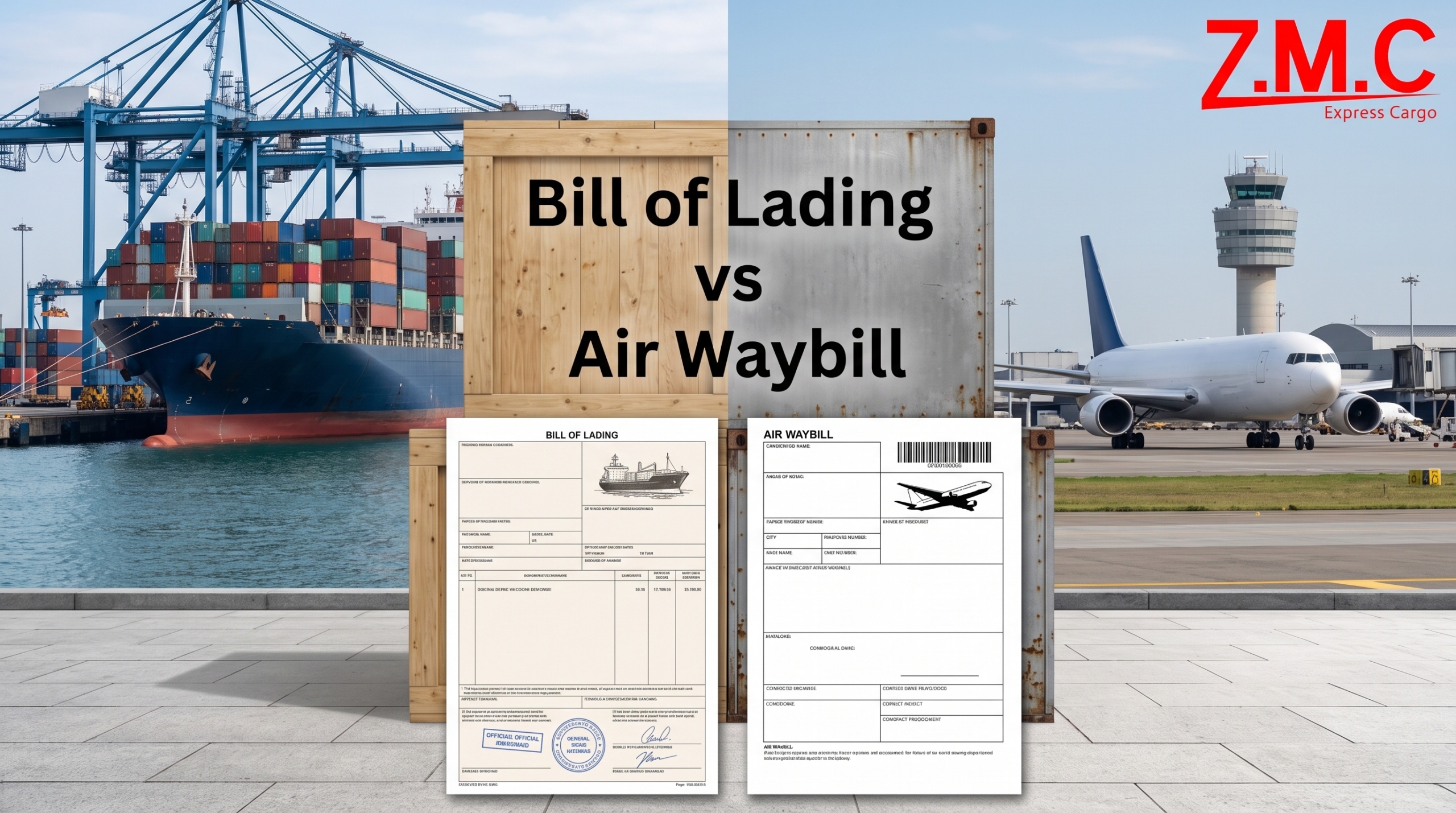
Every shipment needs a transport document. For sea cargo, that’s a bill of lading. For air cargo, it’s an air waybill. Both look alike, but they don’t work the same way. In this guide, you’ll learn the bill of lading vs air waybill basics in plain words. You’ll also get a simple checklist, so your goods clear customs in Dubai or Iraq without delays. Know more about Bill of landing vs Air Waybill.
What Is a Bill of Lading?
A bill of lading (B/L) is the main document for sea freight. The shipping line or forwarder issues it once your goods are loaded on the ship.
In fact, it does three jobs:
- Receipt. It proves the carrier got your cargo.
- Contract. It sets the terms of carriage between you and the carrier.
- Title. It shows who owns the goods. In most cases, you need the original to collect the cargo.
Because a B/L can prove ownership, you can sell the goods while they are still at sea. To do that, you simply endorse the document to the new buyer. That’s why banks often ask for it under a letter of credit.
Types of Bills of Lading You May See
Not every B/L works the same way. So it helps to know the main types before you sign a deal.
- Straight B/L. It names one consignee. Only that person or company can collect the cargo. Also, you can’t pass it to a new buyer.
- To order B/L. It says “to order” or “to the order of” a bank or buyer. As a result, the holder can endorse it and pass it on.
- Bearer B/L. Whoever holds it can collect the goods. For this reason, it’s risky and rarely used.
- On-board B/L. It confirms the goods are on the ship. Banks usually ask for this one.
- Received for shipment B/L. It shows the carrier has the goods, but they are not loaded yet.
- Clean B/L. The carrier found no damage when it took the cargo.
- Claused B/L. The carrier added a note about damage or missing items. Banks often refuse this type.
In short, always ask your supplier which type they will send. Then check that it matches your sales contract.
What Is an Air Waybill?
An air waybill (AWB) is the main document for air freight. The airline or its agent issues it when it accepts your cargo.
Like a B/L, it works as a receipt and a contract. However, it is not a title document. So you can’t sell the goods by passing it on. Instead, the airline hands the cargo to the consignee named on it.
Each AWB has an 11-digit number. The first 3 digits show the airline. That’s why you use this number to track your shipment online. Today, most airlines also use the electronic version, known as the
e-AWB.
What You’ll Find on an AWB
An AWB packs a lot of details into one page. Here are the fields that matter most to you:
- Shipper and consignee. These are the sender and the receiver.
- Airport of departure and destination. For example, Guangzhou to Dubai (DXB).
- Number of pieces. This is the count of boxes or pallets.
- Gross weight. It’s the real weight of the cargo.
- Chargeable weight. Airlines charge by the higher of real weight or size-based weight. So large, light boxes can cost more than you expect.
- Nature of goods. A short, clear description of what’s inside.
- Handling notes. For instance, “keep cool” or “fragile”.
Once you know these fields, you can spot errors in seconds.
Paper is also fading out. Most airlines now accept the e-AWB, so the data travels online instead of in a pouch. Likewise, some shipping lines now offer electronic bills of lading. Before you choose one, check that your bank and your buyer accept the digital version.
Bill of Lading vs Air Waybill: 6 Key Differences
Here is the bill of lading vs air waybill comparison at a glance:
| Point | B/L (sea) | AWB (air) |
|---|---|---|
| Transport mode | Sea freight | Air freight |
| Proof of ownership | Yes, it is a title document | No |
| Can you sell goods in transit? | Yes, if it is a “to order” B/L | No |
| Originals | Usually a set of 3 | No original needed to collect |
| Who collects the cargo | The holder of the original | The named consignee |
| Speed of release | Slower if originals travel by courier | Fast, often on arrival |
How Each Document Moves, Step by Step
It helps to picture the journey of each document.
For sea freight:
- First, your supplier books space with a shipping line or forwarder.
- Next, the goods are loaded, and the carrier issues the B/L.
- Then the supplier sends the originals to you or your bank by courier.
- Meanwhile, the ship sails. The trip from China to Jebel Ali can take a few weeks.
- After that, you or your agent hand over an original B/L to the carrier.
- Finally, the carrier issues a delivery order, and customs clearance starts.
For air freight:
- First, your supplier drops the cargo at the airline or its agent.
- Next, the airline issues the AWB. A copy flies with the cargo.
- Then the flight lands, often within a day or two.
- After that, the airline tells the consignee the cargo has arrived.
- Finally, your agent clears customs and collects the goods.
As you can see, the sea route has more steps where paper can get stuck.
Why the Bill of Lading vs Air Waybill Difference Matters
In practice, the gap affects both your cash and your timing.
First, think about release. With sea freight, the ship may arrive before the paper originals do. Then your cargo waits at the port, and storage fees start to add up.
Next, think about payment. If you pay by letter of credit, the bank usually needs a clean, on-board B/L. On the other hand, air cargo moves fast, so buyers often pay by bank transfer instead.
Finally, think about risk. Since an AWB names the consignee directly, a mistake in that name can block delivery. In short, small errors cost real time.
Faster release for sea cargo
Waiting for paper originals is slow. Luckily, there are two faster options.
- Telex release. The supplier hands the originals back to the carrier at the loading port. Then the carrier sends a message to its office at your port. As a result, you can collect the cargo without any paper originals.
- Sea waybill. This works much like an AWB. It names the consignee and is not a title document. So the carrier releases the cargo to that named company.
Both options save time and courier costs. However, they only suit trusted suppliers. That’s because once the goods are released, you lose the security of holding the original. Also, banks don’t accept them under most letters of credit.
What to Check on a Bill of Lading vs Air Waybill
Before your goods ship, use this checklist. Also, ask your supplier to send a draft copy first.
- Shipper and consignee. Names and addresses must match your commercial invoice exactly.
- Notify party. Add your customs agent or forwarder, so they get the arrival notice.
- Goods description. Keep it clear and specific. Vague words like “parts” or “samples” can trigger an inspection.
- HS code. Make sure it matches the code on the invoice and packing list.
- Weight and number of packages. These must match the packing list.
- Ports or airports. Check the loading point and the final stop, such as Jebel Ali, DXB, Baghdad or Erbil.
- Freight terms. Look for “prepaid” or “collect”. This should match your Incoterm.
- Document type. For sea cargo, confirm if it’s an original B/L, a telex release or a sea waybill.
Once you get the final version, compare it with your other shipping documents. These include the commercial invoice, the packing list and the certificate of origin.
Shipping to Iraq: Extra Points to Check
Many of our clients bring goods from China to Dubai, then on to Iraq. In that case, a few extra checks help.
- Final consignee. If the goods go on to Iraq, make sure your papers show the right buyer for each leg.
- Certificate of origin. Iraqi customs usually asks for it. So request it from your supplier early.
- Road transport papers. Trucks from Dubai to Iraq use their own road transport document. Therefore, the details must match your B/L or AWB.
- Product rules. Some goods, such as food, medicine and electronics, may need extra approvals. For that reason, ask your forwarder before you order.
- Arabic names. Spell company names the same way on every paper, whether in English or Arabic.
Getting these right means fewer questions at the border and faster delivery to Baghdad, Erbil or Basra.
Common Mistakes That Delay Clearance
- Spelling errors in the consignee name or address.
- Weights that don’t match across the papers.
- Lost originals. As a result, you may need a bank guarantee to release the cargo.
- Wrong freight terms, which can lead to extra charges at arrival.
- Missing documents for regulated goods like food, medicine or electronics.
- Late drafts. If you see the draft after the ship sails, fixing it costs more.
- Wrong Incoterm. If the terms don’t match your contract, you may pay freight twice.
Most of these errors are easy to catch. In fact, a five-minute check of the draft can save days at the port.
House vs Master Documents
When you use a forwarder, you often get two layers of paperwork, too. The carrier issues a master document to the forwarder. That’s the MBL for sea or the MAWB for air. Then the forwarder issues a house document to you, called an HBL or HAWB. For this reason, the house copy is usually the one importers check. Still, your forwarder should share the master number, so you can track the ship or flight.
Why does this matter? If a problem comes up at the port, the carrier only knows the master number. So keep both numbers in your records. That way, you can follow up fast with the carrier or your forwarder.
How ZMC Express Handles Your Shipping Documents
At ZMC Express, we check your papers before your cargo moves. Our team handles
air freight,
sea freight
and
land freight
from our base in Dubai Airport Free Zone.
- Customs clearance. Our
customs clearance service
files your declaration and works out duties in advance. - Freight forwarding. As your
freight forwarder in Dubai,
we issue and review your transport documents. - Airport handling. Our
airport handling team
receives and moves air cargo at the airport. - Tracking. You can follow each shipment with
online tracking.
Not sure which mode fits your cargo? Read our guide on
air freight vs sea freight.
Buying from China? See
how to book shipping from China to UAE
and our
China to Iraq shipping guide.
Also, check out our tips on
pre-shipment inspection in China.
FAQ
Is a bill of lading the same as an air waybill?
Who issues a B/L?
Can I collect sea cargo without the original B/L?
What if I lose the original B/L?
What is the difference between a sea waybill and an original B/L?
What is chargeable weight on an AWB?
How do I track my AWB?
What documents does customs in Dubai need?
How long does customs clearance take in Dubai?
Need Help With a Bill of Lading vs Air Waybill?
In the end, the right paperwork keeps your cargo moving and your costs down. So, before your next order ships, let us check your bill of lading vs air waybill details for you. Our team will review your papers, fix errors early and clear your goods fast.
Or message us on WhatsApp: UAE +971 56 992 6986 · Iraq +964 750 722 2333