Pre-Shipment Quality Inspection in China | ZMC Express
Pre-Shipment Quality Inspection in China: A Complete Guide for Importers (2026)
Pre-shipment quality inspection in China is the process of verifying that goods are manufactured correctly, packed to spec, and match your purchase order — before they leave the factory and before you pay the final balance. A qualified third-party inspector visits the factory, tests a sample of units against your requirements, and delivers a written report, typically within 24–48 hours.
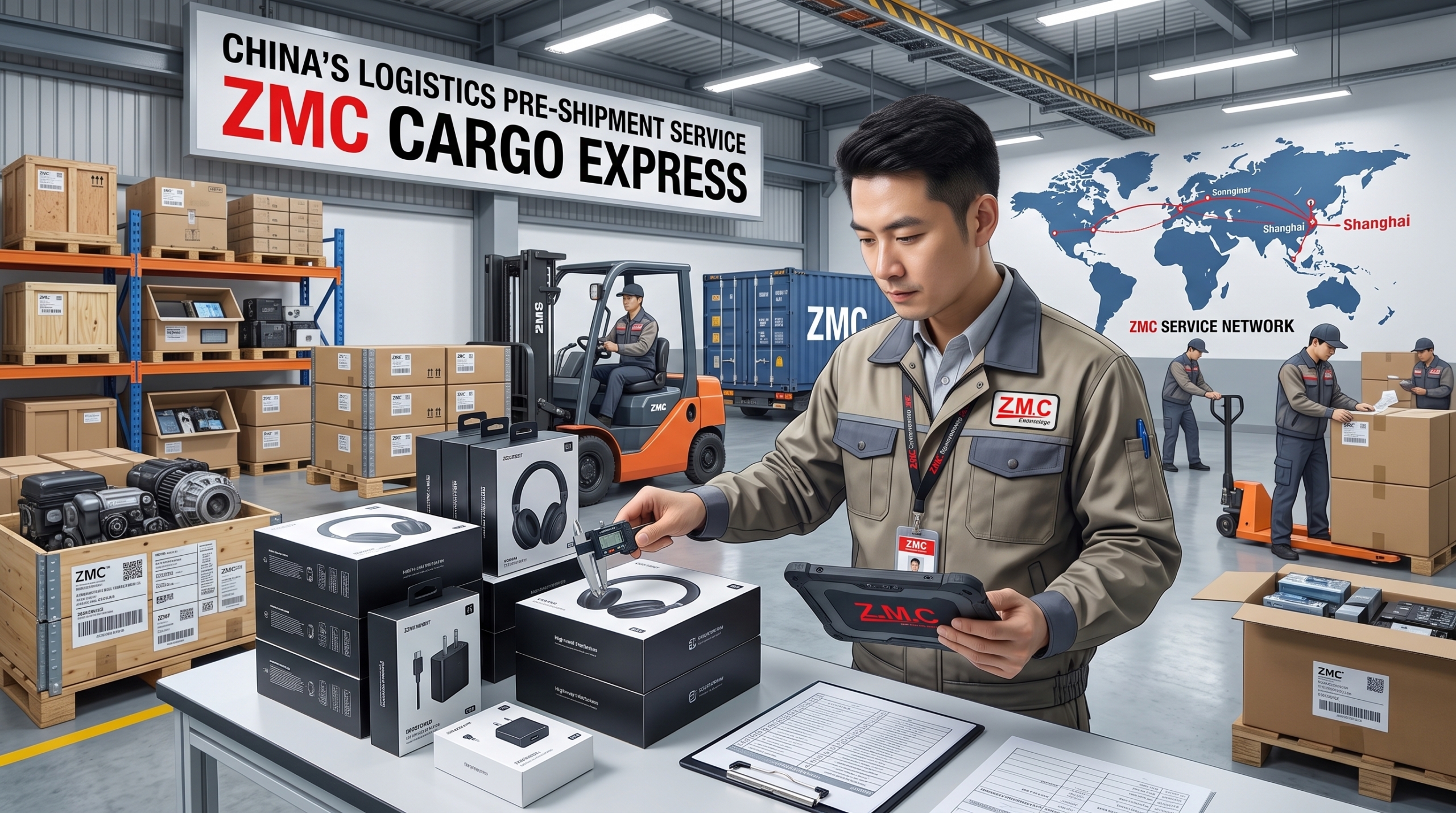
For importers sourcing goods from Chinese manufacturers, a pre-shipment inspection (PSI) is the single most cost-effective risk control available. At $100–$400 per inspector-day, it costs a fraction of what a rejected shipment, customs hold, or product recall will set you back.
This guide covers everything you need to know: what inspectors actually check, how AQL sampling works, what a PSI costs in 2026, when to schedule it, and — critically — how inspection integrates with your freight forwarding and customs clearance when shipping to the UAE or Iraq.
What Is a Pre-Shipment Quality Inspection?
A pre-shipment quality inspection is an independent, third-party audit of a production batch conducted at the supplier’s factory before goods are loaded and shipped. The inspection is performed when at least 80% of the goods are produced and 80% are packed — giving the inspector access to a representative sample of the actual shipment.
The inspector is not employed by the factory or the importer. They follow a standardised checklist aligned with the buyer’s purchase order and internationally recognised quality standards, most commonly ISO 2859-1. After the inspection, they produce a detailed report with photographs, measurements, defect logs, and a clear pass or fail verdict.
PSI is distinct from three other types of quality control:
Conducted at the very start of production to verify materials and setup before the run begins.
A mid-production audit when roughly 20–30% of goods are complete.
Supervision of goods being loaded into the container, confirming quantity, condition, and seal numbers.
PSI is the most widely used of the four because it’s the last checkpoint before goods leave China and become your legal responsibility.
Why Pre-Shipment Inspection Matters for Importers
Importers sourcing from China face a structural information gap: you’re ordering from a factory thousands of kilometres away, often based on samples and photographs, with limited visibility into the actual production run.
That gap is where problems enter the supply chain. A 2024 study by a major QC platform found that over 30% of unaudited shipments from Chinese manufacturers contained defects above the acceptable threshold — ranging from cosmetic flaws to functional failures and mislabelled quantities.
The financial consequences compound quickly. Consider a retailer who orders 3,000 units at $12 each ($36,000 order value). If 15% of units arrive defective, that’s 450 units that cannot be sold. Add returns processing, customer refunds, replacement sourcing, and the cost of a second shipment, and a single missed inspection can generate $10,000+ in losses — against an inspection cost of $250–$350.
For importers shipping from China to UAE or shipping from China to Iraq via Dubai, the stakes are higher still: UAE and Iraqi customs authorities can reject non-conforming goods at the port of entry, leaving you with goods in a bonded warehouse, accruing demurrage charges, and no clear path forward.
PSI prevents this by catching issues while the goods are still at the factory, where rework is cheap and time is available.
What Does an Inspector Check During a Pre-Shipment Inspection?
A standard PSI covers eight core areas. The specific checklist is customised to the product, but these categories are universal:
1
2
3
4
5
6
7
8
How AQL Sampling Works: The Standard Explained
AQL (Acceptable Quality Limit) is the backbone of pre-shipment inspection. It answers one practical question: how many defective units in a sample are acceptable before the whole batch fails?
The framework is defined by ISO 2859-1, the international standard for sampling inspection by attributes. Here’s how it works in practice:
Step 1: Determine your batch size. If your order is for 3,000 units, your batch size is 3,000.
Step 2: Choose your inspection level. The most common is General Inspection Level II. For smaller orders or high-risk products, Level I reduces the sample size. For critical goods, Level III increases it.
Step 3: Identify the AQL for each defect type. Defects are classified into three tiers:
| Defect Type | AQL Level | Definition | Example — 3,000 units |
|---|---|---|---|
| Critical | AQL 0 — Zero tolerance | Safety hazards or legal violations | Any single critical defect fails the batch |
| Major | AQL 2.5 | Failures affecting function or clearly visible | Inspect 125 units; fail at 11+ defects |
| Minor | AQL 4.0 | Cosmetic issues unlikely to affect purchase | Inspect 125 units; fail at 15+ defects |
Step 4: Consult the sampling table. For a batch of 3,000 units at General Level II, the inspector examines 125 units. At AQL 2.5 for major defects, the batch passes if 10 or fewer defective units are found, and fails at 11 or more.
Why AQL matters for your negotiations: You should specify your AQL thresholds in your purchase order before production begins. If your supplier knows your acceptance criteria upfront, they can’t dispute the inspector’s verdict. Failing to agree on AQL in advance is one of the most common mistakes importers make — and one of the most expensive.
What Does Pre-Shipment Inspection Cost in China?
Pre-shipment inspection in China is priced on a per-man-day basis. In 2026, the standard rate is $100 to $400 per man-day, with the wide range reflecting differences in:
- Inspection company reputation: Global firms (SGS, Bureau Veritas, Intertek) charge at the higher end ($250–$400/day). Reputable regional specialists typically charge $150–$250/day.
- Factory location: Factories in major manufacturing hubs (Guangzhou, Shenzhen, Yiwu, Ningbo) are easier to reach. Remote factories may add travel surcharges — sometimes half a day’s fee plus a flat travel cost.
- Product complexity: Simple consumer goods require one man-day. Complex machinery, electronics, or multi-component assemblies may require two or more.
- Urgency: Rush inspections (24-hour notice) typically carry a 20–30% premium.
Regional specialists / mid-tier firms
SGS, Bureau Veritas, Intertek
Rush surcharge (24-hour notice)
What should be included in the fee: A legitimate inspection fee covers sampling, product photography, defect documentation, and the written report. Be wary of companies that charge separately for the report or photos — this is a red flag for transparency.
The cost-benefit calculation is simple: At $250 for a one-day inspection on a $20,000 order, you’re spending 1.25% of your order value for protection against the 15–30% loss that a failed shipment typically generates. The inspection pays for itself if it catches even one significant problem.
When Should You Schedule a Pre-Shipment Inspection?
Timing is critical. The inspection window has two constraints:
Not too early: The inspection should happen when at least 80% of units are produced and at least 80% are packed. Inspecting too early means the sample won’t represent the final batch, and the inspector can’t check packaging quality.
Not too late: The inspection must happen before the goods are loaded into the container and the Bill of Lading is issued. Once goods are in transit, you’ve lost your primary point of leverage.
The practical timeline:
Contact your inspection company at least 3–5 business days before you need the inspection completed. Factories in remote areas may require more lead time.
Most inspection companies deliver their written report within 24–48 hours of completing the inspection.
Build 3–5 days of buffer between your target inspection date and your latest cargo ready date. If an inspection fails and the supplier needs time for rework, you don’t want to be holding a booking on a vessel that sails in 48 hours.
ZMC Express’s freight forwarding services in Dubai include timeline management that accounts for supplier-side quality checks — so your shipping schedule doesn’t lock you out of a re-inspection window.
Pre-Shipment Inspection and the Certificate of Conformity (CoC) for Iraq
For importers shipping from China to Iraq, there is an additional layer of compliance that connects directly to quality inspection: the Certificate of Conformity (CoC).
Iraq requires a CoC for a wide range of imported goods — particularly electronics, appliances, construction materials, and food products. The CoC is issued by an approved international inspection body (such as Intertek or SGS) and certifies that the goods comply with Iraqi national standards (IQS).
How CoC inspection differs from a standard PSI:
CoC inspection is a regulatory requirement, not a buyer option. It must be conducted by a government-approved inspection body, not just any third-party inspector. The CoC must accompany the shipment and be presented to Iraqi customs at entry. Goods arriving without a valid CoC can be refused entry or held for extended periods.
For shipments routing through Dubai, ZMC coordinates CoC inspections with approved bodies at origin (China) or at Dubai’s transit facilities. Read the full route breakdown in our guide to China to Iraq shipping via Dubai, which covers CoC requirements by product category.
What Happens After the Inspection Passes?
When your inspection report shows a pass verdict, the goods are cleared for shipment. Here’s the sequence that follows:
- Release the balance payment. Most payment terms (30% deposit / 70% balance) tie the final payment to a passed inspection. This protects you: you only pay the balance once you’ve independently confirmed the goods meet your standards.
- Confirm your freight booking. Notify your freight forwarder that goods are ready. At this point, the cargo ready date is confirmed and your vessel or flight booking is locked in.
- Choose your shipping mode. For most FCL (full container load) shipments from China to the UAE or Iraq, sea freight is the cost-effective default. Time-sensitive goods or high-value, low-volume cargo often move more efficiently by air. See our comparison of air freight from China and sea freight options to match the mode to your needs. For smaller quantities, our FCL vs LCL shipping guide helps you decide whether to consolidate or take a dedicated container.
- Customs clearance at destination. The inspection report and any compliance certificates accompany the commercial invoice, packing list, and Bill of Lading. Our customs clearance services cover UAE and Iraqi entry requirements, ensuring your documents are aligned with destination-country regulations from the moment the goods leave China.
What Happens If the Inspection Fails?
A failed inspection is not the end of the world — it’s the system working as designed. Here’s the standard resolution path:
If defects are reworkable (incorrect labels, minor assembly errors, packaging issues), the supplier reworks the affected units and a re-inspection is scheduled. Most suppliers accept this when the defect rate is documented clearly in the inspection report.
If defects are limited to a minority of units, you may accept the conforming units and reject the defective ones, adjusting the balance payment accordingly.
For severe or widespread defects, rejecting the shipment and seeking a refund or replacement is the appropriate course. The inspection report is your legal documentation — it proves the goods failed your agreed specifications before you accepted delivery.
The key: always establish, in your purchase contract, which party bears the cost of re-inspection after a failure. If the failure is the supplier’s fault, they should cover re-inspection costs. Get this in writing before placing the order.
Shipping from China? ZMC Handles Quality Inspection & Freight End-to-End
ZMC Express operates its own team in China, covering major manufacturing hubs including Guangzhou, Shenzhen, Yiwu, and Ningbo. Our team can visit your supplier’s factory before the shipment leaves, verify that goods match your purchase order, and organise export documentation and cargo collection — so you’re not depending on an unknown third party for one of the most important steps in your import process.
Once goods pass inspection and are ready for shipment, our end-to-end service handles air and sea freight, transit through Dubai, customs clearance, and last-mile delivery to the UAE and across all 11 of our Iraq branches.





Leave a Reply
Want to join the discussion?Feel free to contribute!