Air Freight vs Sea Freight | ZMC Express
Air Freight vs Sea Freight: Which One Is Right for Your Shipment?
Every shipment starts with the same question: should I ship by air or by sea? Get it wrong and you’re either paying far more than you need to, or watching your urgent cargo sit on a slow boat for six weeks. Get it right and you cut costs, hit deadlines, and keep your customers happy. Learn about Air freight vs Sea Freight and which is right for you.
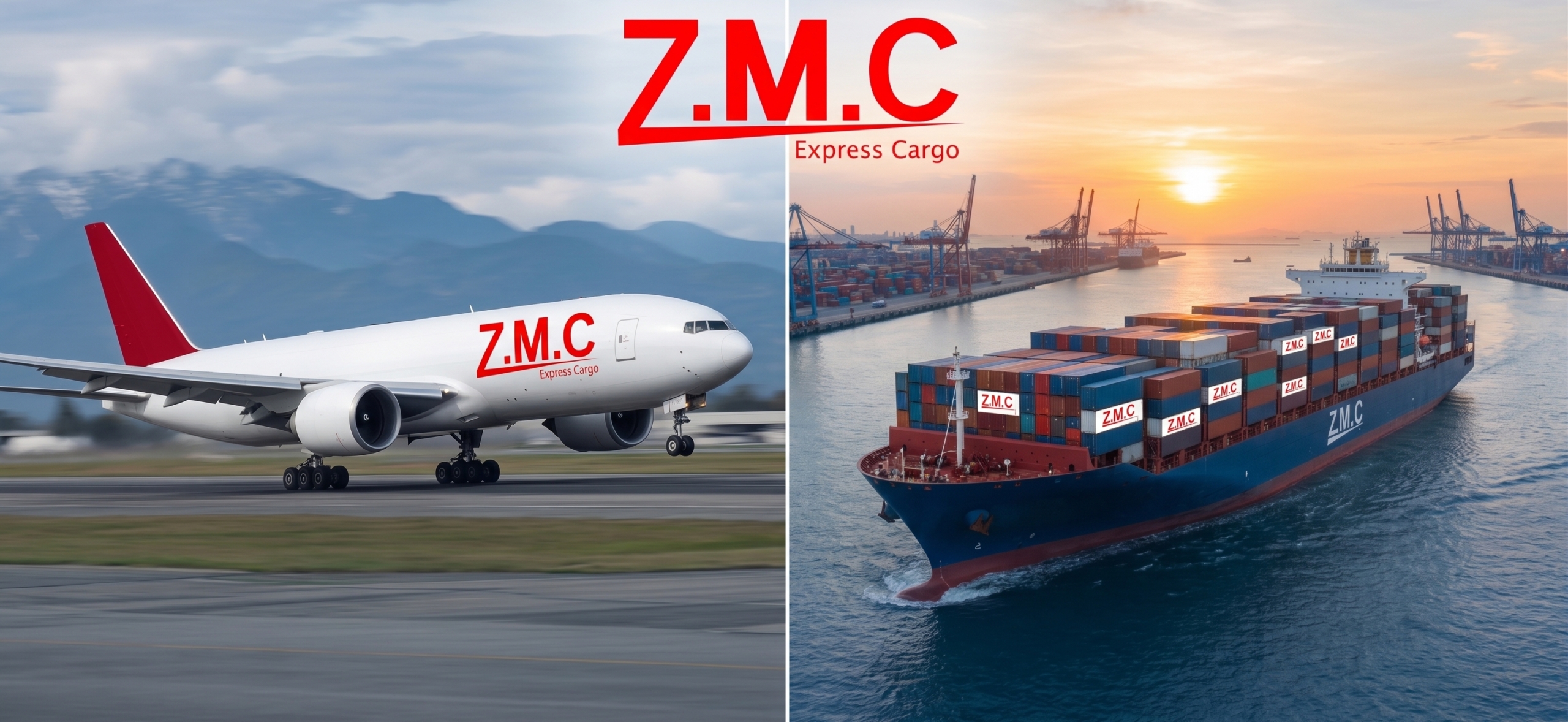
At ZMC Express Cargo, we’ve handled over 1.9 million shipments — from urgent electronics flown into Dubai overnight to bulk commodity containers shipped from China to Iraq via sea. We’ve seen what works and what doesn’t. This guide gives you a clear, honest breakdown so you can make the call with confidence.
Quick Comparison: Air Freight vs Sea Freight
| Factor | Air Freight | Sea Freight |
|---|---|---|
| Transit Time | 1–8 days | 15–50 days |
| Cost (per unit) | Higher — $2.50–$8/kg | Lower — $40–$110/CBM (LCL) |
| Best For | Urgent, high-value, lightweight cargo | Bulk, heavy, non-urgent goods |
| Weight Limit | Practical up to ~300 kg | No practical limit |
| Carbon Footprint | Higher (500–600g CO₂/tonne-km) | Lower (10–40g CO₂/tonne-km) |
| Reliability | Very high (fixed airline schedules) | Variable (port/weather disruptions) |
| Customs Clearance | Faster (airport, 24–48 hrs) | Slightly longer (port, 2–5 days) |
| China → Dubai Example | 3–5 days | 20–35 days |
What Is Air Freight?
Air freight is the transportation of goods by aircraft — either in the cargo hold of a passenger plane (belly cargo) or on a dedicated freighter aircraft. It’s the fastest mode of international shipping and the go-to option when time is the priority.
For businesses importing goods into the UAE or Iraq, air freight services connect you to virtually any destination in the world in as little as 24–72 hours for major routes. ZMC Express operates out of Dubai with direct connections across Asia, Europe, and the Americas — meaning your goods clear customs and arrive at your door faster than any other mode.
Air freight is measured and priced by:
- •Actual weight (kg) or volumetric weight (L × W × H ÷ 6,000), whichever is greater
- •The route (origin–destination pair)
- •Service level (express vs. standard air cargo)
What Is Sea Freight?
Sea freight — also called ocean freight — moves goods inside shipping containers on cargo vessels across the world’s oceans. It’s slower than air but dramatically cheaper for large or heavy shipments, and it has no practical weight ceiling.
Sea freight services come in two main formats:
- •FCL (Full Container Load): You book the entire container — 20ft or 40ft. Best for large-volume shipments. You control the space, pay a flat rate, and your goods don’t share space with other cargo.
- •LCL (Less than Container Load): You pay only for the cubic metres your cargo occupies inside a shared container. Ideal for smaller shipments that don’t fill a full box.
For importers shipping from China to Iraq or the UAE, sea freight is typically the default for anything above 300 kg or 2 CBM — and it can reduce your freight cost by 70–80% compared to air.
Air Freight vs Sea Freight — Cost Comparison
Cost is usually the first question. Here’s the honest answer:
Air freight typically costs between $2.50 and $8 per kilogram depending on the route, carrier, and cargo type. On a China-to-Dubai lane, expect roughly $3–$6/kg for standard air cargo.
Sea freight is priced per CBM (cubic metre) for LCL, or as a flat rate per container for FCL. LCL rates on the China-Dubai lane typically run $40–$110 per CBM. FCL rates for a 20ft container from Shanghai to Jebel Ali start around $800–$1,800 depending on market conditions.
The break-even point for most shipments is somewhere between 150–300 kg. Below that, LCL sea freight and air freight become cost-competitive when you factor in the longer transit time and potential inventory holding costs.
Real-world example: 500 kg, 3 CBM shipment from Shenzhen to Dubai
~$2,500–$3,000
~$300–$350
but 25–35 days in transit
Not cost-efficient at this volume
For high-volume importers, sea freight wins on cost for any shipment above 300 kg — unless the product or deadline demands speed.
Air Freight vs Sea Freight — Transit Times
Air Freight Transit Times (door-to-door from China to UAE/Iraq)
- •Shanghai / Shenzhen to Dubai: 3–5 days
- •Dubai to Baghdad / Erbil: 1–2 additional days via ZMC’s connections
- •Europe to Dubai: 2–4 days
Sea Freight Transit Times (port-to-port, China to UAE)
- •Shanghai / Ningbo to Jebel Ali (Dubai): 20–28 days
- •Shenzhen to Jebel Ali: 22–30 days
- •Onward to Iraq via road: add 3–7 days
When to Choose Air Freight
Air freight is the right call when:
1. Your cargo is time-sensitive
Product launches, seasonal inventory, replenishment for fast-moving items — when delays cost you sales or customer trust, air is the only option.
2. Your goods are high-value relative to their weight
Electronics, pharmaceuticals, luxury goods, jewellery, precision instruments. The cost of air freight is small compared to the value of the inventory in transit, and the shorter transit window reduces exposure to damage, loss, and theft.
3. Your shipment is under 300 kg
Below this threshold, air freight becomes cost-competitive with sea — especially when you account for warehousing, insurance, and capital tied up in slow-moving inventory.
4. You’re shipping perishables or temperature-sensitive goods
Fresh produce, certain chemicals, and medical supplies often cannot tolerate a 30-day sea journey. Air freight, combined with our airport ground handling services, keeps goods moving from aircraft to warehouse without breaks in the cold chain.
5. Your product has a short shelf life or market window
Fashion, trending consumer goods, and time-limited promotional items need to land quickly or they lose their commercial value.
When to Choose Sea Freight
Sea freight wins when:
1. Volume and weight are high
If you’re moving a container’s worth of goods — furniture, building materials, automotive parts, bulk consumer products — sea freight is 70–80% cheaper than air. The maths are impossible to ignore.
2. Your lead times allow for longer transit
Established importers with reliable demand forecasting can plan 6–8 weeks ahead and ship by sea without disrupting their supply chain. The savings go straight to the bottom line.
3. You’re shipping heavy, dense, or oversized cargo
Industrial machinery, steel, vehicles, construction equipment — air freight isn’t viable for these goods. Sea freight, specifically FCL, was built for this.
4. You’re shipping dangerous goods or restricted items
Many hazardous materials and oversized cargo that cannot fly are routed by sea. Our team handles customs clearance and documentation for both modes to keep your cargo compliant.
5. Your margins are tight and freight cost is a major factor
For commodities, bulk food products, and low-margin consumer goods, sea freight is the only way to make the numbers work.
Pros and Cons — Side by Side
Air Freight
- ✓Fastest transit times — days, not weeks
- ✓High reliability and schedule consistency
- ✓Lower risk of damage (less handling)
- ✓Ideal for high-value, time-sensitive cargo
- ✓Faster customs clearance at airports
- ✕Significantly higher cost per kilogram
- ✕Weight and size restrictions apply
- ✕Higher carbon footprint per tonne-km
- ✕Not suitable for oversized or hazardous cargo
Sea Freight
- ✓Far lower cost for large or heavy shipments
- ✓No practical weight or size ceiling
- ✓Suitable for bulk, hazardous, oversized cargo
- ✓Lower carbon emissions per tonne-km
- ✓FCL gives full control over your container
- ✕Slow transit times (15–50+ days)
- ✕Vulnerable to port congestion and weather
- ✕More complex documentation (Bill of Lading)
- ✕Capital tied up in transit — affects cash flow
Air Freight vs Sea Freight for UAE and Iraq Routes
Shipping to and through the Middle East has its own set of considerations — and it’s where ZMC Express has nearly two decades of expertise.
For Shipments into Dubai (UAE)
Dubai’s Jebel Ali Port is one of the world’s top 10 container ports — sea freight into Dubai is fast, efficient, and well-serviced. For air, Dubai International Airport and Al Maktoum Airport offer extensive connections. Either mode works well into Dubai, with the choice driven by cargo type and urgency.
For Shipments into Iraq
Iraq presents unique logistical challenges — limited deep-sea port access, customs complexity, and last-mile infrastructure. Air freight directly into Baghdad International Airport or Erbil International Airport is often the preferred route for time-sensitive or high-value goods. Sea freight typically routes via Jebel Ali with onward land freight into Iraq — adding 4–7 days but reducing cost significantly. ZMC Express has 11 branches across Iraq and deep expertise in Iraqi customs.
China to Iraq Shipping via Dubai |
Shipping from China to Iraq: Via Dubai and Direct Routes
For E-Commerce Businesses
Our Cash on Delivery (COD) service and real-time shipment tracking work across both air and sea shipments — critical for e-commerce platforms managing customer expectations in the region.
Environmental Impact — Air vs Sea Freight
- •Air freight emits approximately 500–600 grams of CO₂ per tonne-kilometre
- •Sea freight emits approximately 10–40 grams of CO₂ per tonne-kilometre
Sea freight produces roughly 20–50 times less CO₂ per unit of cargo moved. For businesses with sustainability targets or carbon reporting obligations, this difference matters. If you’re shipping by air for speed reasons, it’s worth asking whether better inventory planning could allow a shift to sea on some lanes.
Can You Use Both? (Split Shipments and Multimodal Freight)
Yes — and many experienced importers do. A common strategy:
- •Send the first batch by air to cover immediate demand or a product launch
- •Follow up with a sea freight container at a fraction of the cost for replenishment
This multimodal approach balances speed and cost, and it’s something ZMC Express coordinates entirely. Our freight forwarding team handles the scheduling, documentation, and customs on both shipments — one relationship, not several.
Not Sure Which Option Is Right for You?
With 19+ years of freight experience and over 1.9 million shipments handled across the Middle East, ZMC Express Cargo gives you advice you can trust — backed by real operational expertise.
Request a Free Freight Quote →
Or track an existing shipment in real time.
Conclusion
The air freight vs sea freight decision comes down to four things: urgency, volume, value, and cost tolerance. Time-sensitive, lightweight, or high-value shipments belong on a plane. Bulky, heavy, or price-sensitive cargo belongs in a container.
Most growing businesses end up using both — and the right freight forwarding partner makes it seamless. ZMC Express operates across air and sea, with customs clearance, last-mile delivery, and real-time tracking built in — so you get the right mode every time, without the complexity.
Speak to Our Freight Team Today →