FCL vs LCL Shipping in Dubai. Sea Cargo in Dubai.
What FCL and LCL Shipping Actually Mean in Dubai Sea Freight
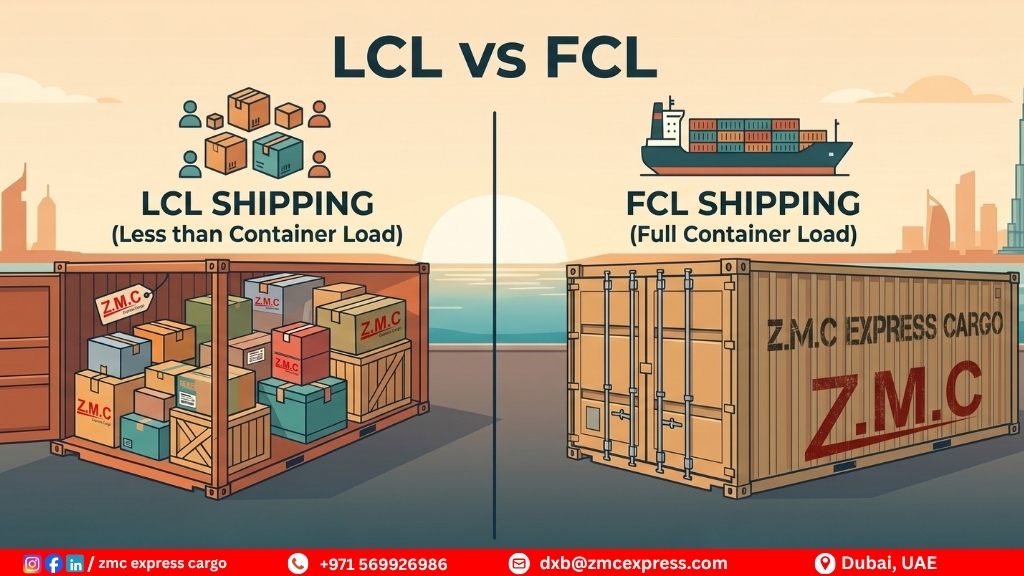
Before comparing FCL vs LCL shipping in Dubai, you need to understand what each term actually means — and why the difference matters far more than most importers realise.
Full Container Load (FCL)
Less than Container Load (LCL)
The distinction sounds simple, but choosing the wrong option on a regular shipping lane can cost a Dubai importer tens of thousands of dirhams every year. The right choice depends on your shipment volume, your timeline, your cargo type, and the specific route you are shipping.
How FCL and LCL Shipping Work at Jebel Ali Port Dubai
Jebel Ali Port is the largest port in the Middle East and one of the ten busiest ports globally. Over 200 shipping lines call at Jebel Ali, connecting Dubai to virtually every major trade port in the world. Understanding how the port processes both FCL and LCL shipments is essential to planning your logistics correctly.
How FCL works at Jebel Ali
With FCL, your freight forwarder books a 20ft or 40ft container at the origin port. Your cargo is loaded and sealed — the container remains sealed until it arrives at Jebel Ali. After clearing Dubai Customs, the container is delivered directly to your warehouse or storage facility. The process is linear, fast, and predictable.
How LCL works at Jebel Ali
LCL involves an additional step at both ends. At the origin, your cargo goes to a Container Freight Station (CFS) where it is consolidated with other small shipments into a shared container. On arrival at Jebel Ali, the container goes to the destination CFS where it is deconsolidated — your cargo is separated from others and then cleared through customs before delivery. This two-step process adds time but removes the cost of paying for unused container space.
2026 FCL vs LCL Shipping Rates from Dubai
Rates change with global demand, fuel surcharges, and seasonal factors. The figures below are current indicative rates as of June 2026 to help you plan and compare. Always request a live quote before booking, these are directional, not contractual.
FCL rates from Jebel Ali Port 2026
Dubai → China
USD 800–1,400
Dubai → UK / Europe
USD 800–1,600
Dubai → USA East Coast
USD 2,000–3,200
LCL rates from Dubai 2026
LCL — Short Haul
USD 35–55 / CBM
LCL — Mid Haul
USD 45–70 / CBM
LCL — Long Haul
USD 60–90 / CBM
Origin Handling (CFS)
AED 150–400
Transit Time — FCL vs LCL Shipping in Dubai
Transit time is one of the most significant practical differences between FCL and LCL shipping in Dubai. LCL is consistently slower than FCL on the same route — typically by 3 to 7 additional days — because of the consolidation and deconsolidation process at both Container Freight Stations.
- Route from Dubai (Jebel Ali)
- Dubai → China (Shanghai)
- Dubai → UK (Felixstowe)
- Dubai → Germany (Hamburg)
- Dubai → USA (East Coast)
- FCL Transit Time
- 18–22 days
- 22–26 days
- 22–28 days
- 28–35 days
- LCL Transit Time
- 22–28 days
- 26–33 days
- 27–35 days
- 33–42 days
- LCL Extra Days
- +4–6 days
- +4–7 days
- +5–7 days
- +5–7 days
When to Choose FCL Shipping in Dubai
FCL is the right choice in these specific scenarios:
- ✅ Choose FCL when…
- Your shipment exceeds 15 CBM — at this volume FCL is almost always cheaper per CBM than LCL
- You need the fastest possible transit time on the route
- Your cargo is fragile, sensitive, or high-value and needs exclusive handling
- You require a sealed, tamper-evident container for security or compliance reasons
- You are shipping hazardous goods — many LCL consolidators cannot accept DG cargo
- You have a hard delivery deadline — LCL’s CFS handling adds unpredictable delays
- You ship regularly and predictably — FCL contracts offer better long-term rates
- ❌ Do not choose FCL when…
- Your shipment is below 10 CBM — you will pay for 20ft of empty space
- You are testing a new supplier or product category for the first time
- Your cash flow cannot support the higher upfront container cost
- Your destination CFS has good handling standards and you have flexible delivery timing
- You are shipping hazardous goods — many LCL consolidators cannot accept DG cargo
- You have a hard delivery deadline — LCL’s CFS handling adds unpredictable delays
- You ship regularly and predictably — FCL contracts offer better long-term rates
When to Choose LCL Shipping in Dubai
LCL is the right choice in these specific scenarios:
- ✅ Choose LCL when…
- Your shipment is below 12 CBM — LCL almost always wins on cost at this volume
- You are a small or growing business that cannot commit to full container volumes
- You need to ship frequently in small batches rather than large seasonal orders
- You are testing demand for a new product before scaling to FCL volumes
- You have flexible delivery timing and can absorb the extra 4–7 days
- Your cargo type is compatible with consolidation — non-hazardous, non-fragile goods
- ❌ Do not choose LCL when…
- Your shipment exceeds 15 CBM — FCL becomes more cost-effective at this point
- You are shipping DG / hazmat cargo — consolidation restrictions apply
- You have strict deadline requirements — CFS handling adds unpredictable time
- Your cargo has unusual dimensions or requires specific stacking restrictions
- You have flexible delivery timing and can absorb the extra 4–7 days
- Your cargo type is compatible with consolidation — non-hazardous, non-fragile goods
Hidden Costs That Change the FCL vs LCL Shipping in Dubai Calculation
The freight rate is only part of the total cost. Several additional charges apply to both FCL and LCL shipments in Dubai — and ignoring them is the most common mistake importers make when comparing options.
Charges that apply to both FCL and LCL
- Bunker Adjustment Factor (BAF): Fuel surcharge added to the base rate. Fluctuates with oil prices and can add USD 50–200 per container.
- Dubai Customs duties: Standard 5% CIF value for most commercial goods. Some categories attract different rates.
- Documentation fees: Bill of Lading, certificate of origin, customs declaration — typically AED 200–500 per shipment.
- Destination terminal handling charges (THC): Jebel Ali port handling fees, applied to all shipments.
Additional charges specific to LCL
- Origin CFS charges: AED 150–400 for consolidation at the origin Container Freight Station.
- Destination CFS charges: Deconsolidation fee at Jebel Ali CFS — typically USD 15–30 per CBM.
- Waiting and storage: If the consolidated container is delayed, your cargo may incur CFS storage fees.
Additional charges specific to FCL
- Demurrage: If you do not collect the container from the port within the free days allowance (typically 5–7 days), daily demurrage charges apply — these can be significant.
- Detention: If the empty container is not returned to the shipping line within the free period, detention charges apply.
- Container cleaning / inspection: Some cargo types require the container to be cleaned before loading at origin.
Why Businesses Choose ZMC Express for FCL and LCL Shipping in Dubai
ZMC Express Cargo has been operating sea freight through Jebel Ali Port for over 20 years. With weekly FCL and LCL consolidations on all major trade lanes, an in-house customs clearance team, and JAFZA warehousing — ZMC provides the full sea freight service from a single partner.
What ZMC Express offers for sea freight in Dubai
- FCL booking — 20ft and 40ft containers: All major trade lanes with weekly sailings and competitive rates direct from carrier contracts.
- LCL consolidation service: Weekly consolidated sailings from China, Turkey, Germany, and India with ZMC’s own CFS partners.
- In-house Dubai Customs clearance: Our licensed team manages every declaration at Jebel Ali, reducing clearance time.
- JAFZA bonded warehousing: Store cargo in Jebel Ali Free Zone before distribution — including bonded storage for goods awaiting re-export.
- Door-to-door (DDP) service: From your supplier’s factory floor to your UAE warehouse — ZMC manages every step under one contract door-to-door delivery.
- Real-time tracking: Both FCL and LCL shipments are tracked from origin loading through to Jebel Ali delivery confirmation.
- Break-bulk and project cargo: For oversized or non-containerisable cargo that fits neither standard FCL nor LCL options.
Frequently Asked Questions
What is the difference between FCL and LCL shipping in Dubai?
When should I choose FCL over LCL shipping in Dubai?
Choose FCL when your shipment exceeds 15 CBM, when you need the fastest transit time, when your cargo is fragile or high-value and requires exclusive handling, or when you are shipping hazardous goods.
How much does FCL shipping from Dubai cost in 2026?
Current 2026 FCL rates from Jebel Ali: Dubai to China USD 800–1,400 per 20ft container; Dubai to India USD 350–700; Dubai to UK/Europe USD 800–1,600; Dubai to USA East Coast USD 2,000–3,200. Always request a live all-in quote as rates fluctuate.
How much does LCL shipping from Dubai cost in 2026?
Current 2026 LCL rates from Dubai range from USD 35 to USD 90 per CBM depending on destination. Short-haul routes (India, Pakistan) average USD 35–55/CBM. Long-haul routes (Europe, USA) average USD 60–90/CBM.
Can ZMC Express handle both FCL and LCL shipping in Dubai?